1. MSCA Mobility rule
To be eligible for this PhD position, applicants must not have resided or carried out their main activity (work, studies, etc.) in the country of their first recruiting beneficiary (France or Hungary) for more than 12 months during the 36 months immediately preceding the recruitment date — unless this period was part of a compulsory national service or a procedure for obtaining refugee status under the Geneva Convention.
2. Description of the Work Project
The growing dependence of our human civilization on space systems and the intensifying new space race have effectively transformed space sustainability from a neglected non-issue into a global and intergenerational concern in the course of a decade. The increasing number of space objects launched into Low Earth orbit, the substantive involvement of private actors present, in addition to their manifold benefits, serious and unprecedented challenges, such as (i) regulation of space traffic management, (ii) ex ante regulatory measures to avoid the creation of space debris, (iii) effective regulation of scarce resources such as frequency and orbital slots. The main problem is that the international legal framework is frozen in time, obsolete and needs to be reformed. Space law develops through national legislations, soft law documents and industrial standards. The space industry is booming in several contexts, involving both civilian and military domain, as well as downstream, by increased demand for satellite data in various industries, and upstream, involving governmental conventional missions. These global tendencies force Europe to make fundamental changes in its space policy, including institutional questions if it wishes to be a space power, an autonomous actor in geopolitics.
3 . Core activities
The research project aims to identify policies and regulatory frameworks for Europe that will promote
sustainable, secure and fair space. It focuses on:
Research field:
- Legal sciences
- Political sciences
Required skills:
- Excellent English language skills (French language skills is an advantage)
- Able to conduct research independently
- Good organizational skills
- Proposing de lege ferenda solutions to the identified problems, avoiding over-regulation hampering competitiveness;
- What policy measures could reinforce the European space industry.
- What problems can only be regulated at the international level and how the problems should be resolved;
- How the harmonisation of European space law can be efficient and contribute to the European competitivity;
- How the European institutions should be reformed (ESA, EUSPA, EU);
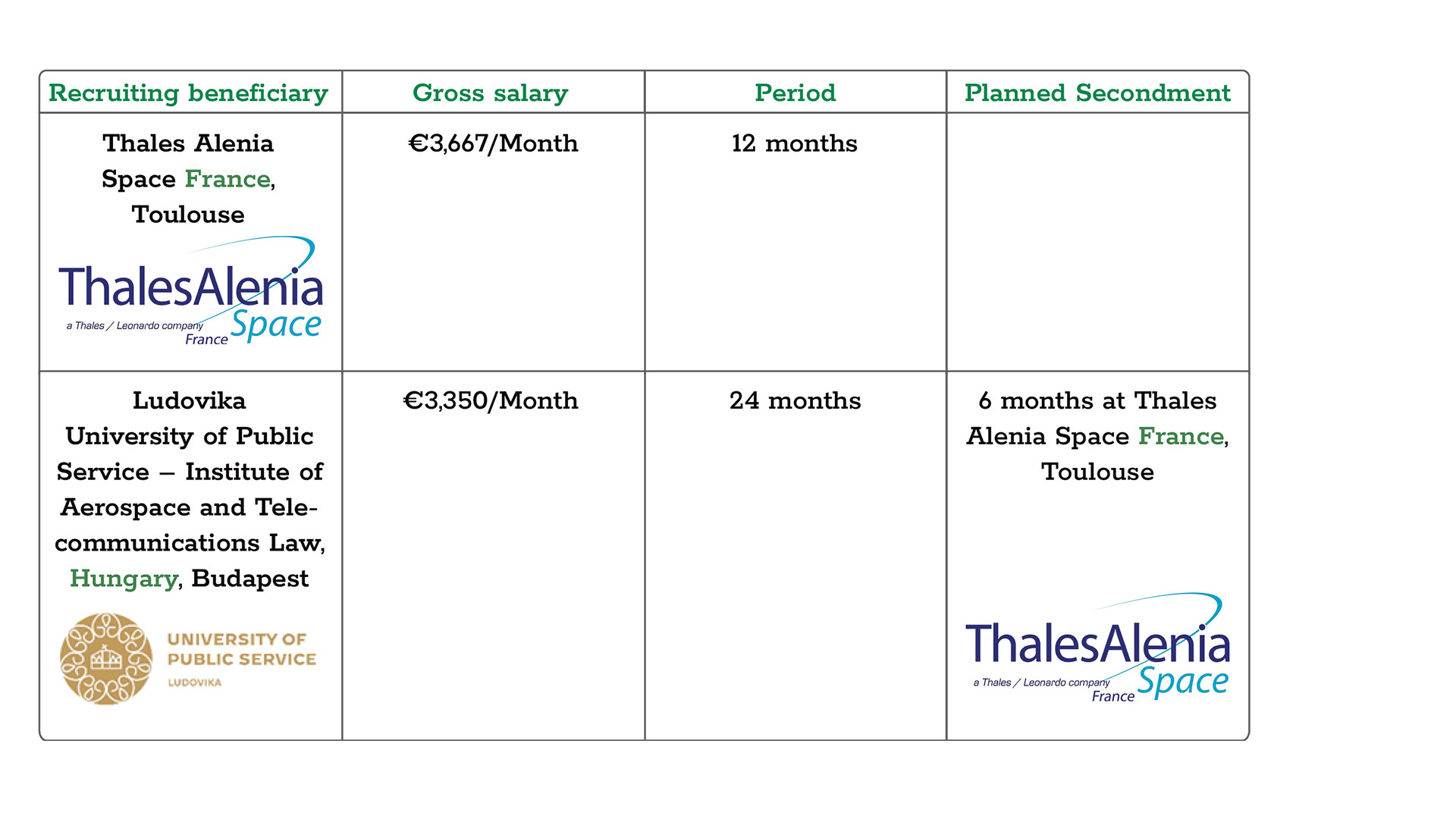
4. Recruitment and secondment plan: