1. MSCA Mobility rule
To be eligible for this PhD position, applicants must not have resided or carried out their main activity (work, studies, etc.) in Italy (country of the recruiting beneficiary) for more than 12 months during the 36 months immediately preceding the recruitment date — unless this was part of a compulsory national service or a procedure for obtaining refugee status under the Geneva Convention.
2. Description of the Work Project
The project aims to define, develop and validate innovative methodologies based on Model-Based Systems Engineering (MBSE) and digital technologies for the sustainable development and optimisation of complex product lines in the space and industrial sectors. The key objective is to integrate environmental sustainability—through strategies such as Life Cycle Assessment (LCA)—and the digitalisation of manufacturing and verification activities—especially Assembly, Integration, and Test (AIT)—directly from the earliest stages of the design process. The candidate will investigate
how MBSE tools and model-centric approaches can support the assessment of environmental impacts, enable efficient management of product variants, and drive virtualisation of traditionally hardware-intensive processes. The project will deliver a methodological framework and concrete use cases demonstrating the potential of this integrated approach for reducing time-to-market, costs, and the environmental footprint of industrial and space systems.
3. Core activities
- Analyze state-of-the-art and future prospects for sustainable design using MBSE methodologies in space and industrial contexts.
- Explore MBSE strategies for integrating LCA and eco-design practices throughout planning, design, and manufacturing phases.
- Apply LCA-driven approaches to guide and optimise product and process choices for minimal environmental impact.
- Investigate industrial best practices related to eco-design and LCA to optimise sustainability across the entire product life cycle.
- Assess and experiment MBSE tools (such Capella and LCA plugin) and other methodologies for sustainable product family engineering and LCA data management.
- Identify key eco-design assets and their incorporation from the initial stages of product and process development.
- Conduct research from both system and product perspectives, ensuring a holistic approach to MBSE and LCA integration.
- Explore the digitalisation of AIT activities, focusing on model-driven virtual testing, simulation, and verification to reduce physical prototyping and dedicated hardware development.
Research field:
- Model-Based Systems Engineering (MBSE)
- Life Cycle Assessment (LCA)
- Eco-design and sustainable engineering
- Digitalisation of industrial and space processes
- Assembly, Integration, and Test (AIT) process optimisation
Required skills:
- Experience in complex systems engineering
- Knowledge of MBSE tools (Capella, SysML, Matlab/Simulink)
- Programming skills (e.g., Python, Java, C++, or similar)
- Interest in digitalisation, environmental sustainability, and process optimisation
- Ability to work on both product and process research topics
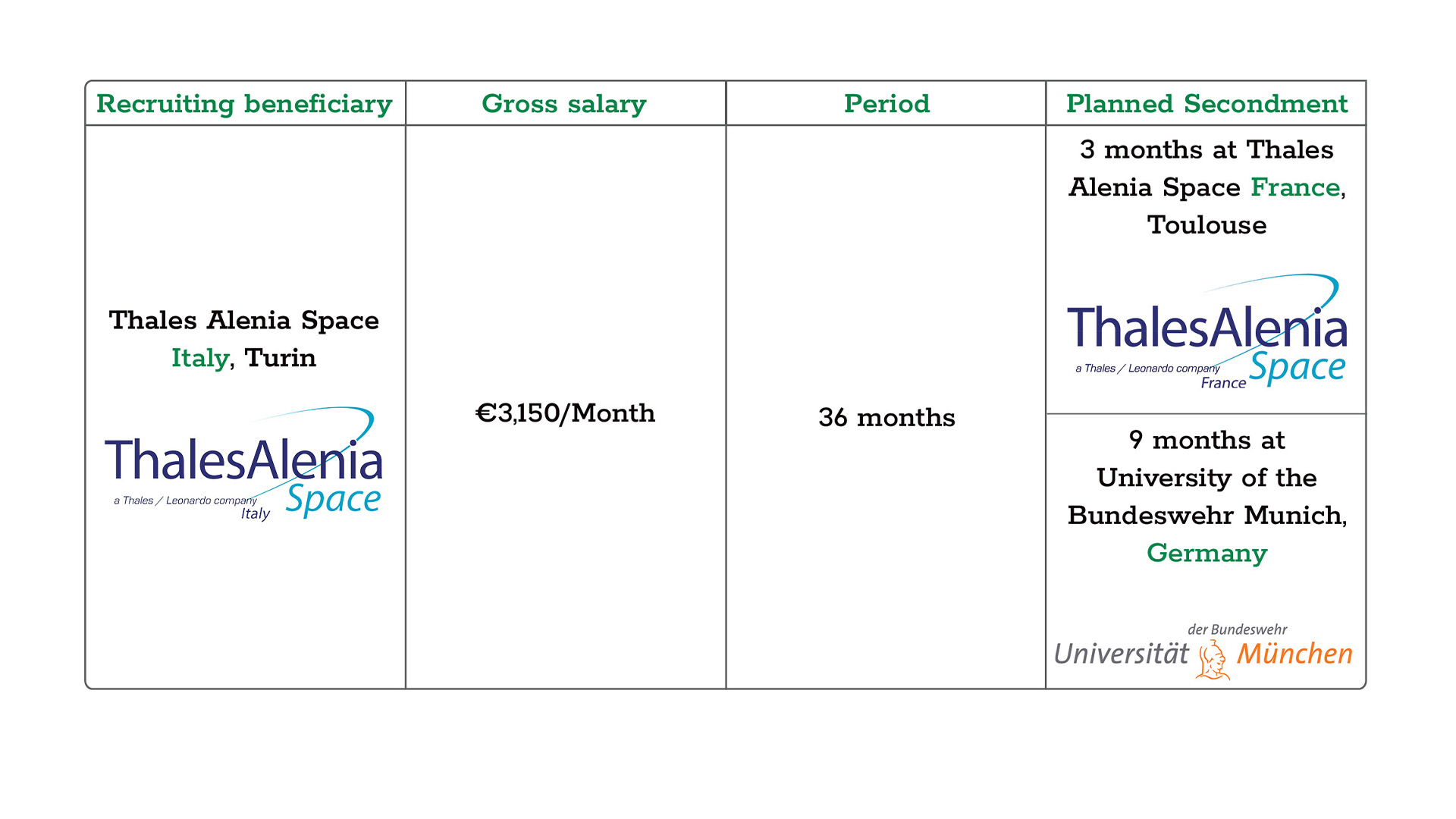
4. Recruitment and secondment plan: