1. MSCA Mobility rule
To be eligible for this PhD position, applicants must not have resided or carried out their main activity (work, studies, etc.) in the country of their first recruiting beneficiary (France or United Kingdom) for more than 12 months during the 36 months immediately preceding the recruitment date — unless this period was part of a compulsory national service or a procedure for obtaining refugee status under the Geneva Convention.
2. Description of the Work Project
In-orbit assembly and manufacturing (ISAM) of large antennas are critical for advancing next-generation space capabilities because they overcome the size and launch constraints of current rockets. Building and deploying large, high-precision antennas directly in space enables the creation of structures far larger and more sensitive than those that can be stowed within a launch fairing, dramatically improving communication bandwidth or Earth observation resolution. This approach also allows for modular upgrades, on-orbit repairs, and adaptive reconfiguration, ultimately reducing long-term mission costs and extending the operational lifespan of space infrastructure.
Several open challenges remain in advancing ISAM of large antennas. One key issue is the design of suitable building blocks for ISAM reflectors, including the optimization of their dimensions and geometry to enable efficient assembly patterns. Trade-offs may include a simpler antenna configuration with compensation at the feed array. In-orbit calibration also remains a critical technical challenge, particularly in case when the antenna is fed by an active array. Radio Resource Management (RRM) could be exploited to maximize the capacity of the system based on the real beams characteristics produced by the geometry of the reflector.
3. Core activities
- Define and investigate a scenario of a large ISAM reflector antenna in terms of its architecture and assembly
- Co-develop manufacturing, radio frequency, digital techniques as well as RRM methodologies to optimise the trade-off between complexity cost and performance
Research field:
- Electrical engineering
- RF/Antenna engineering
- Aerospace engineering
- Telecommunications
Required skills:
- Electromagnetics
- Antenna modelling and design
- Antenna arrays and beamforming
- Experience with programming (Matlab)
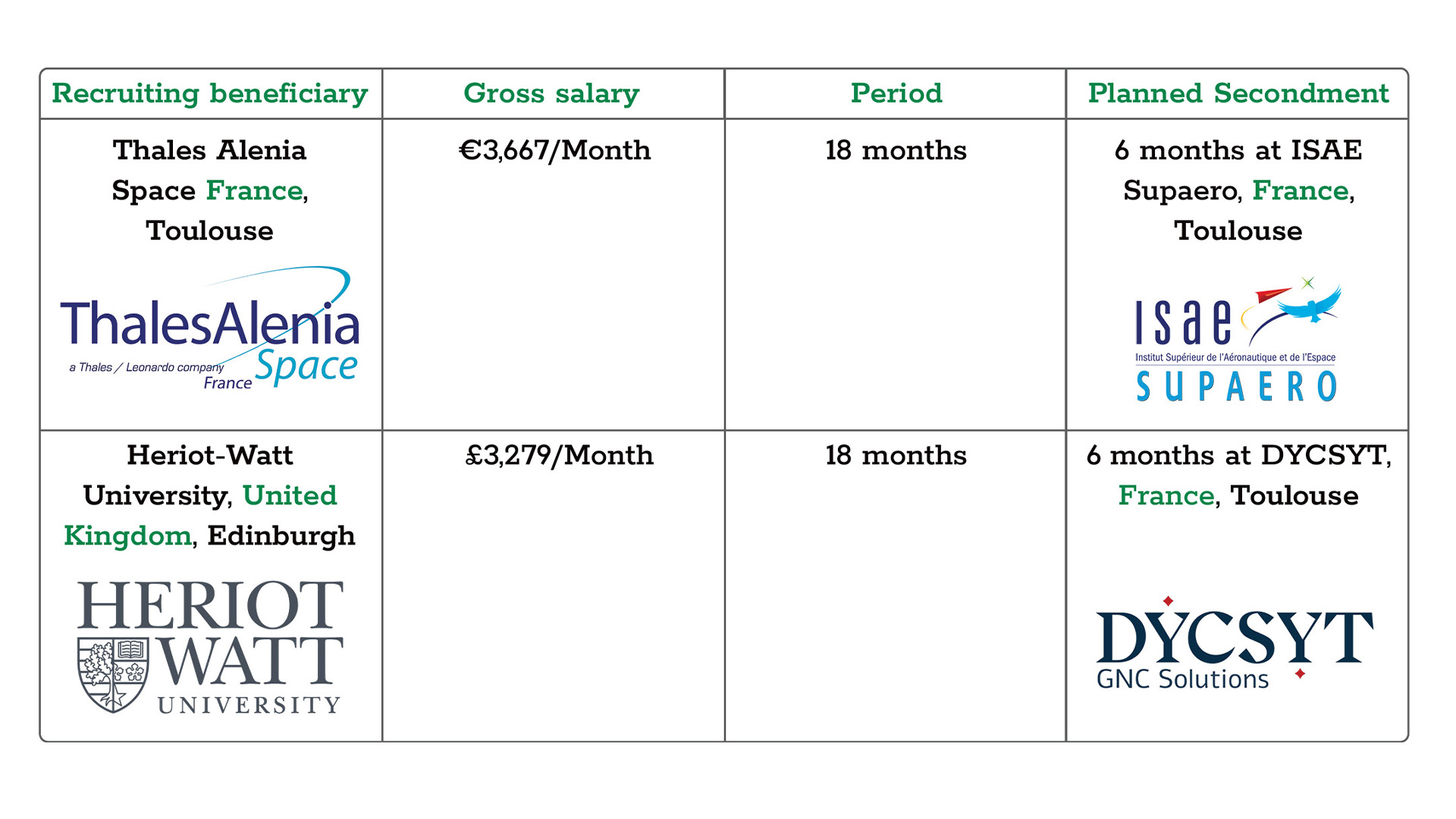
4. Recruitment and secondment plan: