1. MSCA Mobility rule
To be eligible for this PhD position, applicants must not have resided or carried out their main activity (work, studies, etc.) in the country of their first recruiting beneficiary (Spain or Germany) for more than 12 months during the 36 months immediately preceding the recruitment date — unless this period was part of a compulsory national service or a procedure for obtaining refugee status under the Geneva Convention.
2. Description of the Work Project
The space market is undergoing rapid transformation, with new technologies increasing accessibility across all levels. New launchers are lowering costs while enabling higher launch frequency and greater payload capacity to orbit. Technological advances driven by NewSpace are delivering higher performance at reduced cost and on shorter timelines. Both NewSpace and traditional space actors are adopting these innovations to maintain reliability and availability while reducing schedule and cost. Among other outcomes, these developments have significantly enhanced onboard computing capabilities without compromising system performance or reliability. As a result, the industry now has access to technologies with the potential to unfold truly integrated space infrastructures. On the ground, data centres represent the state of the art in computing integration, supporting telecommunications, image and video processing, and AI workloads in versatile environments. Previous studies have examined the deployment of data centres in space, indicating both growing interest and near-term feasibility. Space-based data centres could provide sustainability benefits by eliminating the need for water cooling and instead harnessing solar power while exploiting deep-space radiation for heat dissipation. Nonetheless, significant technical challenges remain and require further development to demonstrate feasibility. Continued technological research is therefore essential to advance these concepts and bring space-based data centres closer to realization. This PhD research will examine the key technological gaps and challenges and propose approaches to overcome them.
3. Core activities
- A detailed definition of system scenarios, balancing computing and storage performance, availability, reliability, thermal and mechanical aspects, and electrical approaches.
- Explore the design of solutions based on AMD / Intel massive processors (Ryzen, Xeon) plus accelerators such as GPUs, state of the art FPGAs and SoCs. Key questions to be investigated are how to ensure large performance and availability along the mission with no disruptions even in the case where electronics may present major events in front of radiation or thermal cycles. The candidate should research on different techniques such as hyper-converged architectures, distributed computing, graceful degradation, to enhance system availability with attention to connectivity, radiation tolerance, thermal and mechanical constraints, and the supporting software ecosystem.
Research field:
- Electrical engineering
- Computing engineering
Required skills:
- Embedded systems
- System engineering
- Reliability concepts
- Electro-thermal-mechanical concepts
- Numerical simulation programming (e.g., Python, Matlab, C++, …)
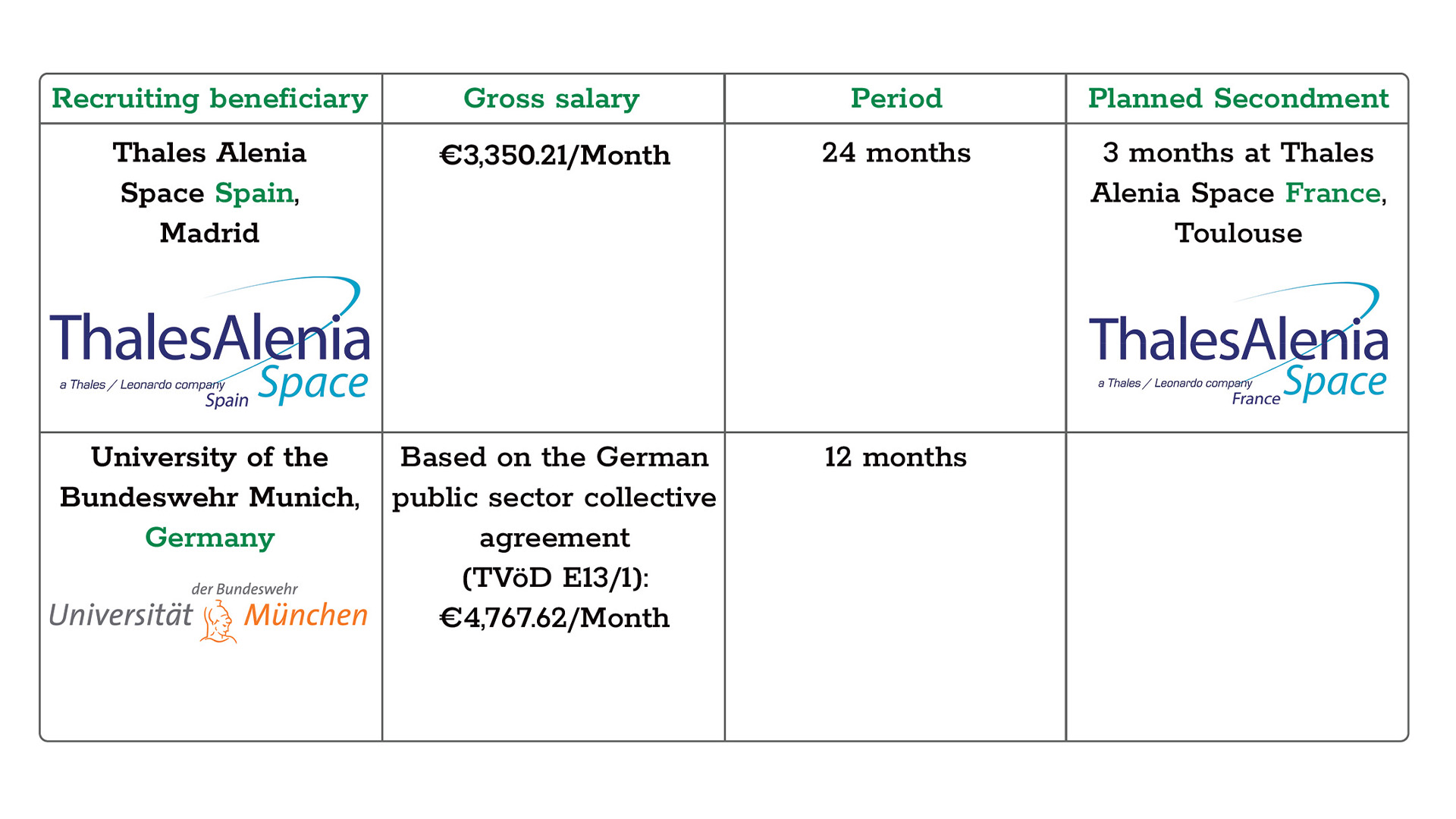
4. Recruitment and secondment plan: