1. MSCA Mobility rule
To be eligible for this PhD position, applicants must not have resided or carried out their main activity (work, studies, etc.) in the country of their first recruiting beneficiary (France or United Kingdom) for more than 12 months during the 36 months immediately preceding the recruitment date — unless this period was part of a compulsory national service or a procedure for obtaining refugee status under the Geneva Convention.
2. Description of the Work Project
The growing demand for wireless connectivity is driving increasing pressure on the radio frequency spectrum, leading to the need for more efficient spectrum use and coexistence strategies between different services. An immediate concern arises in the coordination between heritage Geostationary Satellite Orbit and the rapidly growing Low Earth Orbit constellations operating at the same frequency band. Looking ahead, an emerging research area focuses on frequency sharing between terrestrial mobile services (such as 5G and future 6G networks) and mobile satellite services (MSS), which operate in overlapping or adjacent frequency bands. This topic explores how these systems can coexist without harmful interference, enabling both to deliver high-performance communication capabilities. It involves studying propagation characteristics, interference management, dynamic spectrum access, and coordination mechanisms between ground and space segments to ensure reliable, efficient, and equitable spectrum utilization in an increasingly congested radio environment.
These aspects have been the focus of both emerging regulation as week as research. Regulators, such as the ITU and national spectrum authorities, are developing frameworks that support dynamic and coordinated spectrum use across satellite and terrestrial networks. On the research side, state-of-the-art efforts are focusing on interference modelling, cognitive radio techniques, and advanced beamforming and power control algorithms to enable real-time coexistence between terrestrial and satellite systems. Emerging studies also explore the use of artificial intelligence and machine learning for adaptive spectrum management, as well as network access and optimization across space and ground segments.
3. Core activities
- Identify an emerging use case where frequency coordination across satellite and terrestrial networks is emerging as a priority
- Develop a modelling framework for the associated use case that enables to predict interference
- Investigate interference management techniques across radio, digital and network technologies
Research field:
- Telecommunication engineering
- Electrical engineering
- Aerospace engineering
Required skills:
- Orbital analysis
- Wireless communication systems
- Numerical simulation programming (Matlab)
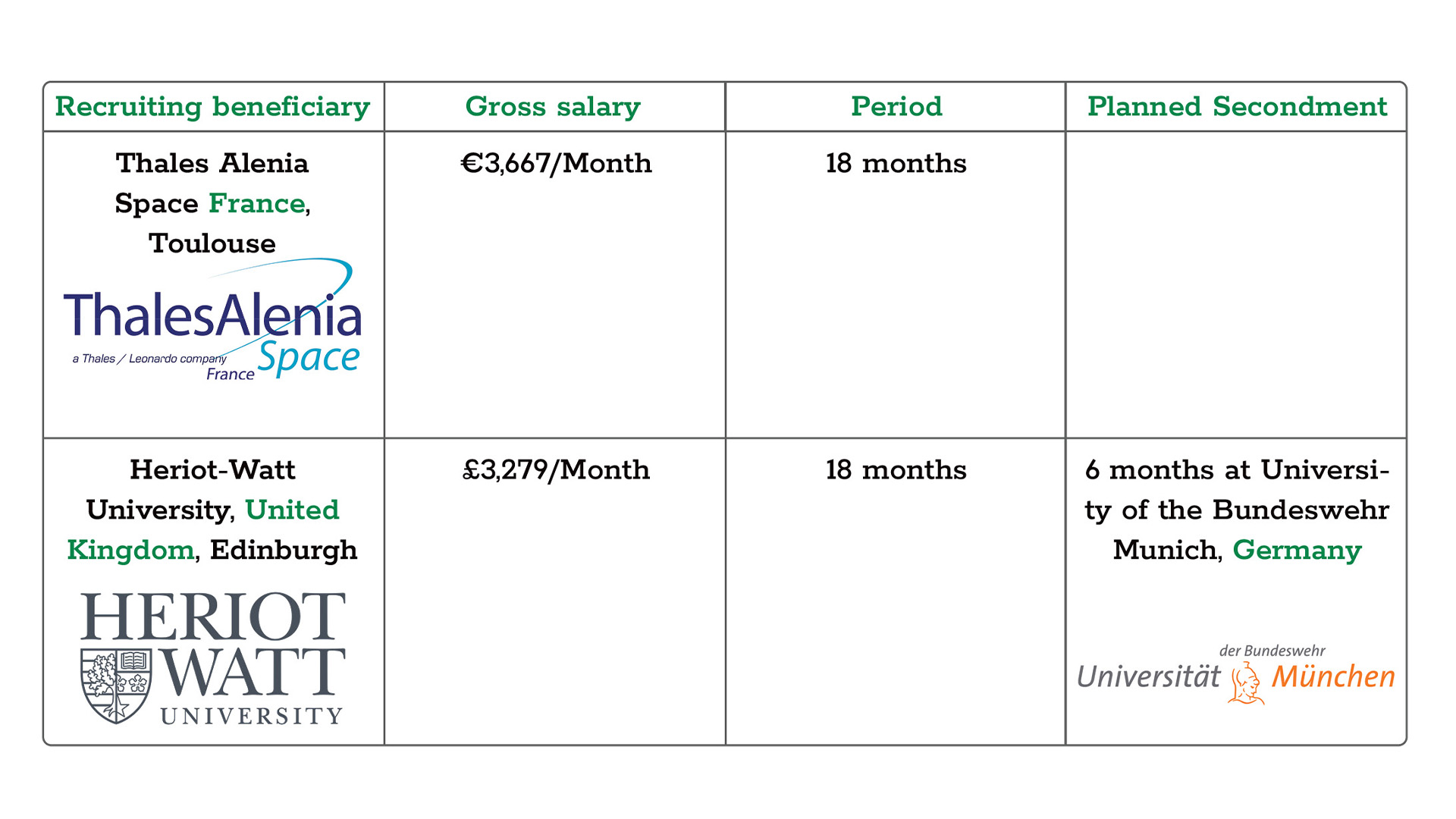
4. Recruitment and secondment plan: