1. MSCA Mobility rule
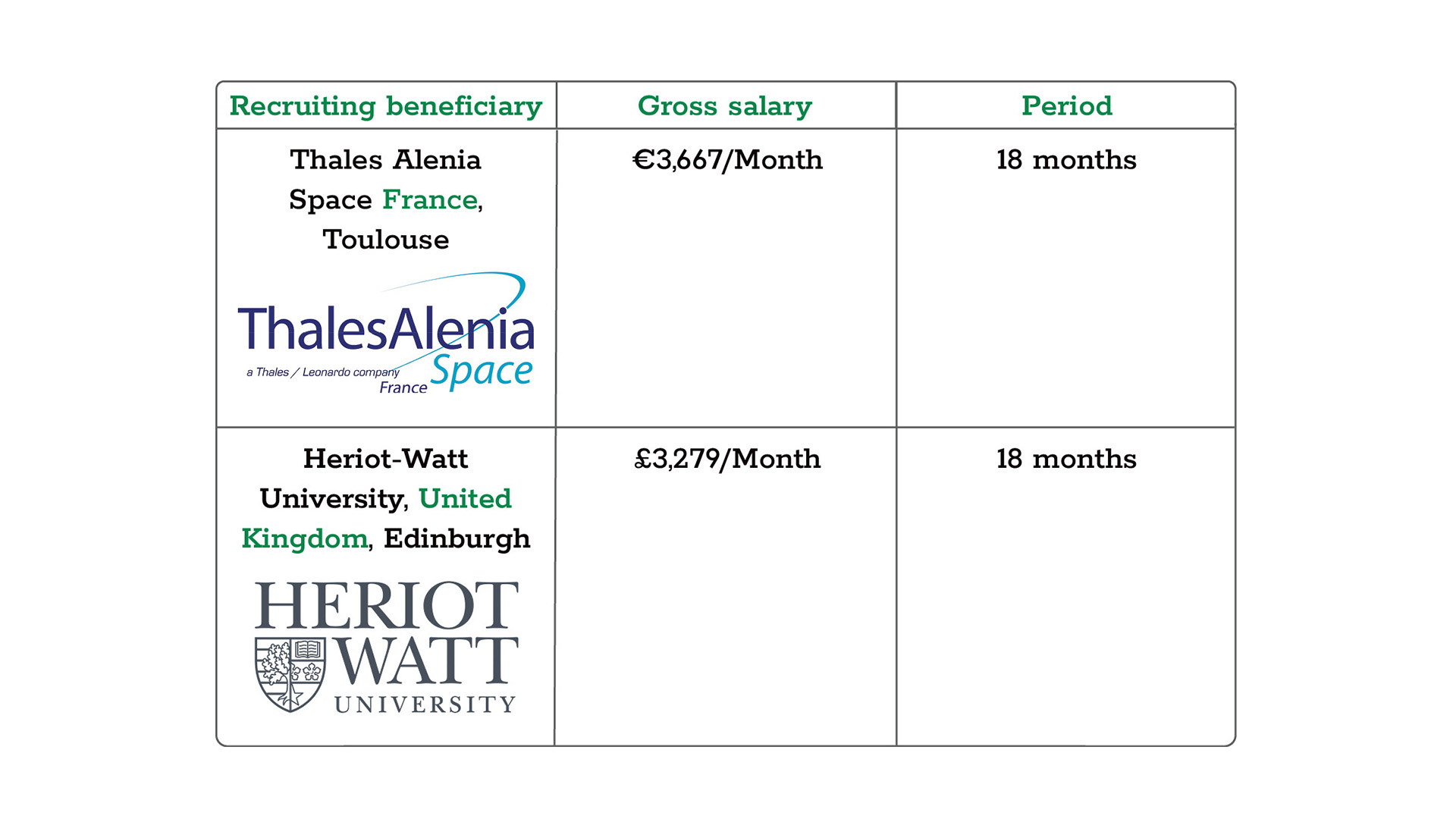
To be eligible for this PhD position, applicants must not have resided or carried out their main activity (work, studies, etc.) in the country of their first recruiting beneficiary (France or United Kingdom) for more than 12 months during the 36 months immediately preceding the recruitment date — unless this period was part of a compulsory national service or a procedure for obtaining refugee status under the Geneva Convention.
2. Description of the Work Project
Emerging Low Earth Orbit (LEO) satellite constellations are increasingly adopting direct radiating arrays (DRAs) as a key technology for next-generation communications. Unlike traditional reflector-based antennas, DRAs consist of electronically controlled arrays of radiating elements that can steer multiple beams dynamically without mechanical movement. This shift is driven by the need for greater flexibility, higher frequency reuse, and improved coverage agility to support broadband services and dynamic user demand on a global scale. Enabled by advances in digital as well as radio frequency and solid state technologies, emerging LEO constellations relying on DRA payloads offer unprecedented agility but also significantly increases the complexity of managing spectrum and power resources across thousands of beams and satellites. Consequently, the development of advanced radio resource management (RRM) techniques becomes essential to fully exploit the potential of DRAs—enabling efficient beam coordination, adaptive interference mitigation, and optimized spectrum sharing between satellites and terrestrial networks. As a result, DRAs combined with intelligent RRM approaches are set to redefine how LEO constellations deliver seamless, high-performance connectivity within the evolving 5G and 6G ecosystem.
A number of research questions remain open when it comes to the RRM of LEO networks with DRA payloads. RF hardware imperfections such as nonlinearities and load-pull effects at the power amplifiers may contaminate the spectral emissions and complicate the modelling of the DRA. This topic has recently been addressed in the framework of the HARMONY MSCA project (https://www.harmony-horizoneurope.eu/papers.html), where tools enabling the end-to-end modelling of a satellite link have been developed for direct-to-device use cases. Extending these tools to broadband satellite links in the Ku- and Ka-bands remain an open question. Accounting for the aforementioned hardware imperfections in a constellation where the satellite experiences rapidly varying traffic as it orbits the Earth raises open questions about which coverage and radio resource management (RRM) strategies will best optimise service delivery.
3. Core activities
- Establish models for accurate and efficient modelling of broadband DRAs in the Ku- and Ka-bands considering hardware imperfections
- Set up simulation frameworks for the satellite payload and the traffic scenarios enabling to predict system performance
- Investigate optimum RRM techniques for given operational scenarios
Research field:
- Telecommunication engineering
- Electrical engineering
- Aerospace engineering
Required skills:
- Orbital analysis
- Wireless communication systems
- Numerical simulation programming (Matlab)
4. Recruitment and secondment plan: