1. MSCA Mobility rule
To be eligible for this PhD position, applicants must not have resided or carried out their main activity (work, studies, etc.) in the country of their first recruiting beneficiary (Germany or Spain) for more than 12 months during the 36 months immediately preceding the recruitment date — unless this period was part of a compulsory national service or a procedure for obtaining refugee status under the Geneva Convention.
2. Description of the Work Project
Space situational awareness (SSA), i.e., the identification, tracking and monitoring of space-borne objects, has traditionally been supported by ground-based systems, such as the EU Space Surveillance and Tracking (EU SST) system. However, expanding SSA capabilities through space-based surveillance is crucial for enhancing both the resolution and real-time responsiveness of these systems.
Space-based surveillance is for example a key component of the EU SST’s long-term R&D roadmap, underscoring its critical importance. Given the severe limitations on spectrum availability, space-based SSA must rely on technologies that do not require dedicated RF frequency allocations. Therefore, situational awareness should leverage passive sensing methods – such as radar systems utilizing signals of opportunity, as well as visible and/or thermal imaging – and active sensing technologies that operate within unregulated spectrum, such as LIDAR. This PhD project aims to develop a distributed satellite system solution that integrates both sensing and processing capabilities to advance space-based situational awareness. In particular, the work will investigate the benefits of incorporating integrated sensing and communication (ISAC) techniques within the satellite sensor network.
3. Core activities
- Detailed definition of the reference scenarios, including the type and spatial distribution of sensors, the on-board processing capabilities and the desired detection and tracking resolution
- Selection and optimization of sensor data processing and fusion techniques to enable a spacebased multisensor system that significantly enhances object detection and tracking performance
Research field:
- Electrical engineering
- Communication engineering
Required skills:
- Signal and data processing techniques,
- Wireless communication systems,
- Numerical simulation programming (e.g. Python, Matlab, C++, …),
- Embedded systems
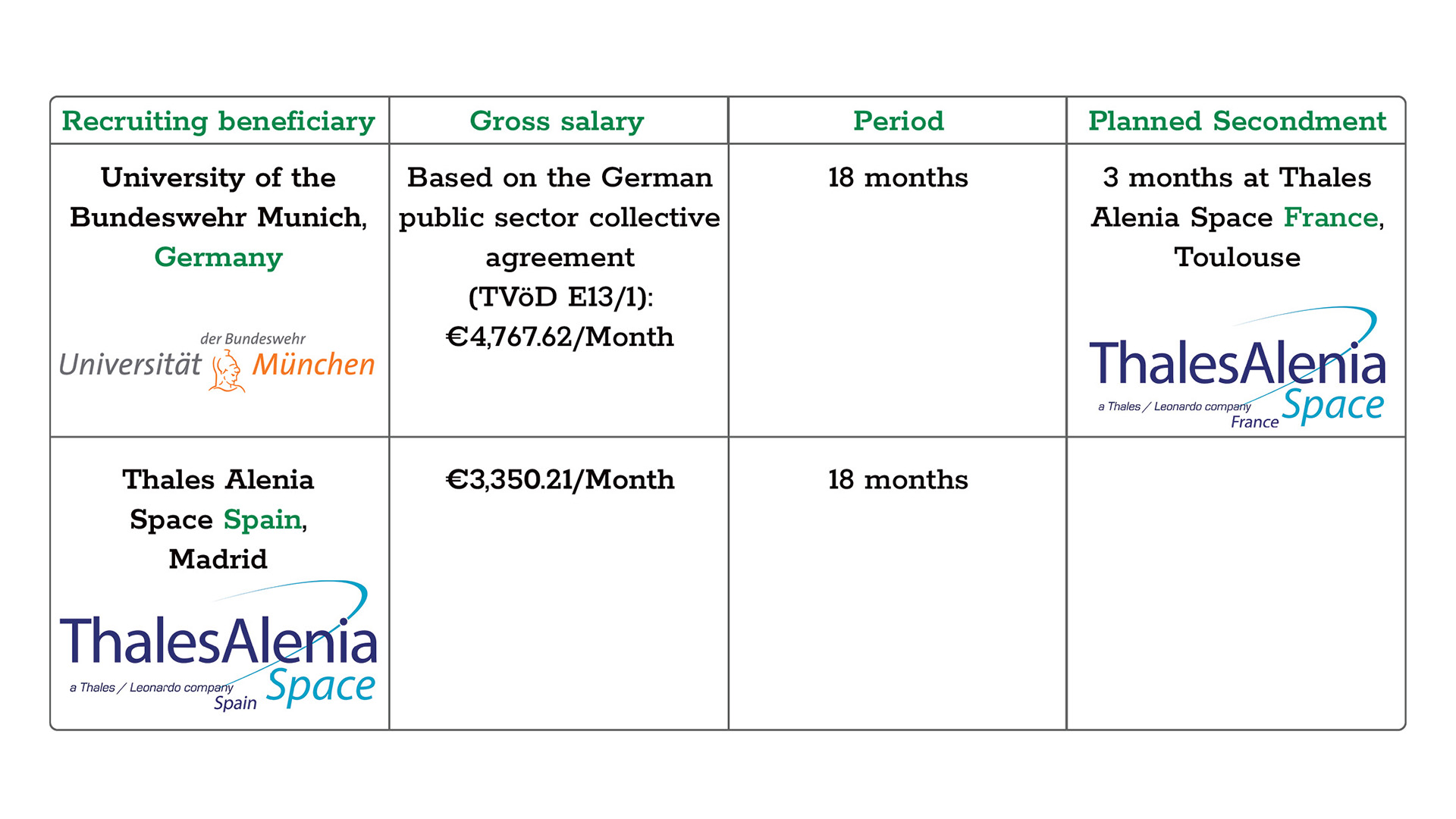
4. Recruitment and secondment plan: